What can you not do without when preparing fragrant rolls, croissants, and buns? Without bake-stable fillings! Many of us have had sad culinary experiences. Perfectly proofed dough, excellent homemade jam from great ingredients. But instead of appetizing buns out of the oven, we got something soaked in juices and hopelessly ruined. To prevent this from happening, bake-stable fillings were invented.
The main requirements for such fillings are:
Non-bake-stable fillings change their structure, separate, and release water when heated. Regular chocolate inside a baking pastry melts, becomes liquid, and eventually leaks out. To prevent such consequences, you can use bake-stable glaze. If you want croissants with real chocolate, choose bake-stable chocolate fillings from Callebaut and Cacao Barry. Dark or milk chocolate, sticks, chunks, drops—there is definitely an option for your favorite pastries in their assortment. And from Callebaut, you will also find delicate chocolate-nut pastes that can be used both as a filling and as a glaze.
How to Make Chocolate Bake-Stable
The fluidity level is indicated on the packaging of heat-resistant chocolate—usually 1 drop. This means its cocoa butter content is minimal. Thanks to this, the chocolate will hold its shape well even at high temperatures. Such a product becomes soft when heated and can be deformed by mechanical stress. After cooling, the chocolate hardens again, completely retaining its original shape. And how deliciously it crunches!
Bake-Stable Fillings for Commercial Pastry Production
In manufacturing, fruit and cream-based fillings are generally used. Fruit jellies and jams mostly contain natural ingredients. The main task in their production is to bind the juice and prevent it from separating during baking or freezing. Pectin does an excellent job with this. Pectin is obtained from fruits, the most common type being apple pectin. It makes the filling thicker. Pectin also serves as a kind of natural preservative. But there is one nuance—pectin only works with a sufficiently high sugar content. It is not suitable as a thickener for low-sugar fillings.
Bake-Stable Fruit Fillings: How to Check the Quality
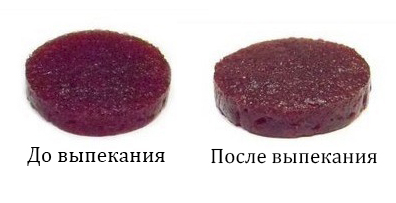
A high-quality filling must withstand temperatures up to 200 degrees Celsius. But there is such a thing as "limited bake-stable properties." The melting point of fillings with limited bake-stable properties ranges from 115 to 200 degrees. You can test a filling for heat resistance using a simple test. It must be applied to the dough, given a shape with clear borders, and baked for about 20 minutes at 200°C. The shape of the filling should remain unchanged, as in the photo.
You can test for bake stability without baking. Leave a small amount of the filling on filter paper at room temperature for half an hour. If you see a trace of moisture absorbed into the paper, it means the filling lacks bake-stable properties. Where can it be used? For filling ready-made baked goods or desserts that do not require heat treatment.
How to Use Heat-Resistant Fillings for Baking
First, you can fill your dough pieces with them and freeze them. Thanks to their heat-resistant properties, the fillings retain their consistency unchanged even after defrosting. Second, depending on the type, you can prepare open or closed pastries with them. If the filling remains exposed, pre-shape it as required. This can be done using a template, a cookie cutter, or other pastry tools.
How to choose: always read the instructions! There are fillings with limited bake-stable properties on the market. To attract attention, the packaging might boast a large "Bake-Stable" label, while the instructions will say "up to 160 degrees." Also, the recommended exposure time may vary in different fillings. That is, it can withstand a conditional 200 degrees, but only for 2-5 minutes. This will be enough for baking small cookies, but this option will not work for large, fluffy buns. In the case of chocolate drops, the recommended exposure time directly depends on the size of the drops.
Where to Buy
Unfortunately, bake-stable fillings are poorly represented in retail stores or supermarkets. However, online stores give you the opportunity to choose the best option for you. The decision to order the necessary ingredients significantly saves time. And if you add the pastry cream, luster dust (candurin), and modeling fondant you will need in the future to your order, you can also save on delivery!